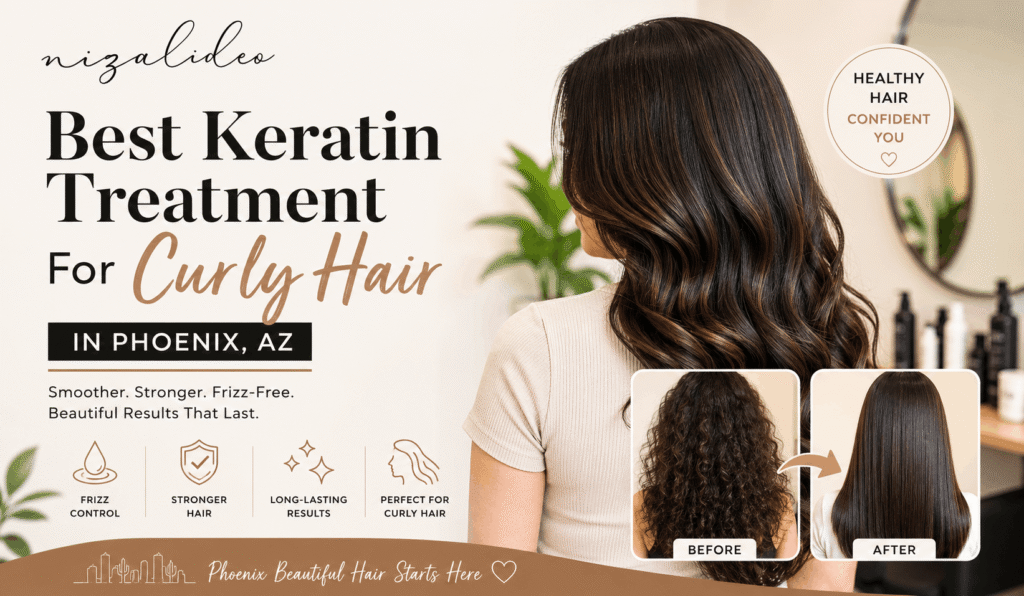
Curly hair can be beautiful, but it can also be tough to handle. There’s frizz, long wash days, humidity, heat styling, dense strands, and a blowout can easily become an afternoon project. And here in Phoenix, it gets even more complicated, since dry heat and all the moisture of monsoon season don’t often agree on what your curls should be doing.
So a good smoothing service can’t really be judged by how straight it gets your hair. For many curly-haired clients, the real benefit is softer texture, less frizz, easier styling, and just enough movement to maintain the personality of the curl. Achieving that has much to do with the technique as it does with the formula itself.
If you’re considering a Keratin Treatment for Curly Hair in Phoenix, it’s useful to first understand how the service actually interacts with your curl pattern, density, porosity, chemical history, and the finish you’re after.
How Can Keratin Treatments Work on Curly Hair?
A smoothing service is meant to make your hair easier to live with – less effort, more polish. Generally, that means applying a smoothing solution and then using heat to seal it into the strand.
But for curly clients, “straight” isn’t always the goal. A good stylist will talk through whether you want to keep visible curl, loosen the pattern a bit, or build a smoother base for the occasional straight style.
Can you loosen the curl pattern without completely straightening it?
For sure-curl-mapping is definitely doable, based on the product and technique used. With any Keratin Treatment Curly Hair service, you should begin with a frank assessment of how much curl you want to retain.
Maybe you’ve got a little wig in your wave, and you just want to chill out the frizz. Or maybe your curls are tight and coarse, and you just want to be able to detangle more easily, or create an overall gentler pattern. Those are two totally different desires. Standardized strength/heat/application for all curls? Inherently flawed. Someone always ends up disappointed.
For a Keratin Treatment For Thick Curly Hair, density adds another layer to think about. Thicker hair usually needs more careful sectioning and product distribution – though thickness alone shouldn’t dictate how much smoothing you get.
How can you reduce frizz while preserving movement?
Controlling frizz doesn’t have to mean surrendering to your texture. Instead, the more intelligent route is determining exactly what’s behind those extra inches – dryness, humidity, roughed-up cuticles, damaged ends, too much heat, or simply the way a curl expands by nature.
Curly and coily hair also tends to run drier and be more prone to breakage, so moisture and gentle handling matter more here than with most hair types.
A Best Smoothing Treatment For Curls should be chosen based on the finish you actually want, and not just whichever option is marketed as “strongest.” If spring, definition, and movement matter to you, speak up before the treatment – not after.
What Should You Expect if You Have Curly or Coily Hair?
The consultation could be the single most critical 15 minutes of the entire appointment. A quality stylist will inspect the state of your strands, previous color or chemical processes, your density, curl pattern, and styling habits before even offering a recommendation.
You should never book a Keratin Treatment Curly Hair appointment based on a photo alone or broad curl “category.” Two people with nearly indistinguishable curls can have a completely different porosity, density, elasticity, and chemical history.
What should you talk about in your consultation?
Start with what you actually want. Be specific about whether that’s:
Less frizz with your curls intact. A looser, more elongated curl pattern. Faster blow-drying and easier detangling. A smoother finish for straight-hair days. Less bulk without too much natural movement.
Bring up your color history, highlights, past straightening services, and how often hot tools touch your hair. Chemical work and frequent heat can leave hair brittle or weakened, so your stylist needs that background before choosing a formula.
If Keratin Treatment For Thick Curly Hair is what you’re after, ask exactly how the stylist plans to work through your density – section size, product saturation, drying technique, and heat all play a part in how even the results turn out.
How should the formula strength be customized to your curl type?
Think in terms of the finish you want, not just “strong” versus “weak.” A lighter approach usually suits someone after frizz reduction and curl retention. A more intensive one tends to appeal to someone who wants noticeably easier straight styling.
Your hair’s current condition should factor in too. Straighteners, chemical services, and heavy heat use can all weaken the hair shaft, especially if there’s already some structural damage.
For Keratin Treatment For Thick Curly Hair, the stylist also needs to consider whether your strands are coarse, fine, porous, color-treated, or some mix of all of it – because “thick” describes density, not necessarily strength.
One good consultation question: “If I choose this formula, what will my curls realistically look like once it starts growing out?” That answer alone can save you from picking a finish that’s a headache to maintain down the road.
Which Keratin Treatment vs. Other Curly Hair Smoothing Options Makes Sense?
No one service is right for every curly client. The best choice comes down to your shampooing frequency, if curl retention is important to you, how often you already choose to wear it straight, and how much time you want back in your morning.
The best option is generally the one that relieves your biggest hair woe, without giving you a brand new one.
How does a silk press compare?
There are many ways to temporarily straighten curly hair, including the silk press, a technique that involves using a flat iron on freshly washed, conditioned, and blown-out hair. Results vary based on hair type, but you can expect a silk press to last about as long as any blowout you’d get at a salon: a handful of days, up to a week or two max. And, as with any heat-based straightening method, silk pressing too frequently can risk damaging your hair. To extend the life of your look, wrap your hair with a silk scarf before bed, and avoid getting your hair wet (difficult, I know).
And, very importantly, make sure your stylist applies a decent heat protectant at the prep step.
When might a lighter treatment be a better fit?
A lighter service usually makes more sense if you’re taming frizz and not eliminating curls, especially if your hair is very heavily highlighted, very dry, fine, fragile, or already sees a lot of heat.
As mentioned by the American Academy of Dermatology, when it comes to hair with curls, you should do your best to cut down on heat and follow proper conditioning protocols.
Your Keratin Treatment Curly Hair consultation should entail an honest conversation about whether your hair can really handle another round of chemical and heat exposure.
You may even want to ask precisely what “formaldehyde-free” means when it comes to whatever product is being used for your treatment, as the FDA has pointed out that even some hair-smoothing treatments sold as “formaldehyde-free” can release formaldehyde when heated, and OSHA has previously documented exposure concerns tied to some smoothing products.
Ask to see ingredient lists and safety documentation if it makes you feel comfortable, and opt for a salon that seems to take ventilation and handling seriously. A marketing label on its own doesn’t tell you exactly what you’re being exposed to.
How Can You Maintain Curly Hair After a Smoothing Treatment?
Aftercare is a key factor in determining if your hair remains manageable or becomes dry, flat, and difficult to deal with after a few weeks. Your stylist ought to provide you with guidance tailored to the product they applied, as the needs for aftercare can differ significantly.
What kind of products are best?
Choose products that help with moisture and won’t flatten your texture. A moisturizing shampoo and conditioner-and a leave-in that aligns with the type of curl you’re dealing with-can go a long way toward keeping things soft and manageable.
The American Academy of Dermatology recommends moisturizing curly hair well, and notes that leave-ins can be especially helpful for anyone with curly, dry, chemically treated, or heat-styling-prone hair.
When it comes to Keratin Treatment For Thick Curly Hair, don’t assume heavier is automatically better. Yes, your thick hair can take the heat conditioning-wise, but if you do too much, your curls will just be coated and flat instead of bouncy.
Stick to the washing schedule and product guidelines given for your specific treatment rather than following whatever routine is trending online.
How can you maintain curl bounce between washes?
The aim is to create less friction, less manipulation, less unnecessary heat. To restyle curls, spray lightly with water or an appropriate curl refresher, then reshape the sections with your fingers rather than a brush.
A loose pineapple, braid, or similar gentle style at night protects the curl pattern. Satin and silk pillowcases and wraps also help reduce friction while you snooze.
For anyone with a Best Smoothing Treatment For Curls, this balancing act is especially important – the treatment should be making daily styling easier, not turning every wash day into a battle for that exact same look.
If you diffuse or blow-dry, keep the heat low. Too much heat is damaging for every hair type.
How Do You Choose a Stylist Experienced With Curly and Textured Hair?
Having experience is important because there are many types of curls. A skilled stylist understands that many different factors can influence results, such as structure, density, porosity, strand thickness, curl pattern, colour history, and previous chemical work.
Find a stylist who can set you up with realistic goals rather than one who will sell you on pin-straight. Ask to see pictures of someone with a similar curl pattern and density as you and how they maintain natural movement.
If you’re seeking Keratin Treatment For Thick Curly Hair in particular, find out how they approach your dense sections and if they customize the application instead of putting every client through the exact same process.
You should also ask:
What degree of curl reduction should I expect? Can I retain enough pattern to wear my hair naturally? How will my color-treated areas affect the process? What ingredients are in the smoothing product? What ventilation practices are used during application? What aftercare products and washing schedule do you recommend? What happens as the treatment gradually wears off?
A solid consultation should leave you with realistic expectations – not pressure to book the strongest service on the menu.
Conclusion
The right smoothing service for curly hair isn’t necessarily the one that leaves you the straightest. Your ideal result might be softer curls, less frizz, faster styling, less bulk, or just a more predictable response to Phoenix’s ever-changing conditions – since the Southwest monsoon season creates a very different styling environment than the region’s dry heat does.
Before booking a Keratin Treatment For Curly Hair in Phoenix, talk through your curl pattern, density, hair history, desired finish, and aftercare expectations with an experienced stylist. And if keeping your movement matters to you, say it clearly, upfront.
With the right consultation and a customized approach, NIZALIDEO The Salon can help you find a smoothing option that actually fits your curls and your everyday routine, instead of forcing your hair into a finish you never wanted.
Ready to Find the Right Smoothing Approach for Your Curls?
Your curls deserve a personalized plan – not a one-size-fits-all formula. Schedule a consultation to talk through your texture, density, desired finish, and maintenance routine before choosing your service.
Call us at (833) 734-7711 or reach out at info@nizalideo.com