By Niza Lideo
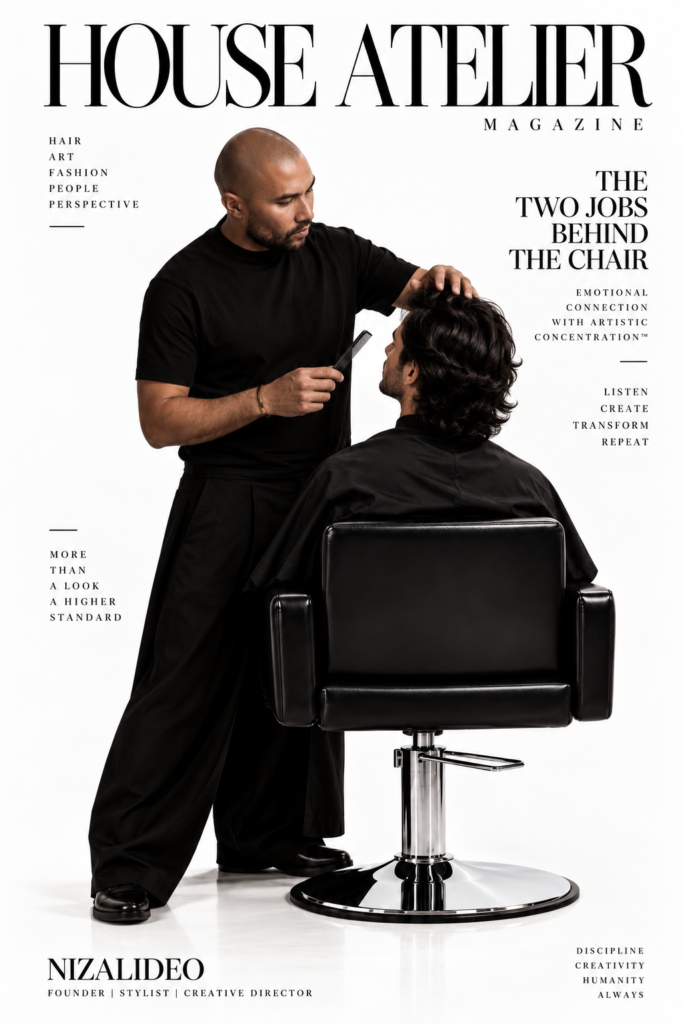
The Two Jobs Behind the Chair is the founder story behind Emotional Connection with Artistic Concentration™ (ECAC™), a philosophy developed through decades of listening, creating, and serving behind the chair.
For decades, I have been doing two jobs behind the chair.
I just didn’t have a name for both of them.
One job happens through the hands.
I am reading shape, weight, movement, texture, density, tension, proportion, timing, formulation, and the countless decisions that determine what happens next.
The other happens through human connection.
I am listening.
Watching body language.
Asking questions.
Remembering something the client said ten minutes earlier.
Reading when somebody wants to talk.
Reading when somebody wants silence.
Recognizing when the person sitting in front of me needs me to lead the experience—and when they need space to lead it themselves.
For years, I moved between those two responsibilities without naming what I was doing.
Now I have a name for it:
Emotional Connection with Artistic Concentration™.
ECAC™.
ECAC is how I stay present with the person in my chair without losing the concentration the work demands.
But the definition came later.
The experience came first.
When a Client’s Story Followed Me Home
One of the moments that stayed with me happened during the year my daughter was graduating from university.
A new client came into the salon with a friend.
I did not know much about either of them when they arrived. They were both young, around the same age as my daughter.
That mattered.
My consultations have never only been about hair.
Of course I need to understand the technical assignment.
What are we changing?
What needs to be corrected?
What does the client want?
What is the condition of the hair?
But I am also trying to understand the person.
How did you find me?
Why now?
Why this change?
What is happening in your life that makes this appointment matter to you?
That is the people side of hairdressing.
As I worked, the conversation opened.
The two young women started telling me pieces of their lives.
They had known each other for years. Their lives had become intertwined. They had supported one another through difficult circumstances.
Then the conversation became heavier.
One of them shared that she had been adopted as a child and later forced out of her home as a teenager after revealing something personal about who she was.
Immediately, my mind went to my daughter.
I started thinking about what seventeen actually means when the person is your own child.
There is a major difference between a young person deciding they are ready to leave home and a young person being told they no longer have one.
One is movement.
The other can feel like removal.
When a young person chooses to leave, even if the parent is worried, there is often still an invisible safety net.
A phone call.
A meal.
A place to return to.
A person who will answer.
When that safety net disappears, the world becomes different.
As she spoke, I found myself imagining my own daughter trying to navigate housing, money, work, adulthood, danger, inexperience, and all the ways a young person can be taken advantage of while simply trying to survive.
Her friend shared that she had also left home.
Not because she had been forced out, but because she did not want her friend to face that situation alone.
That affected me too.
I remember thinking about the loyalty required for a young person to voluntarily leave comfort because somebody they love no longer has it.
And while all of this was happening, I was still doing hair.
That is the part people outside the profession may not understand.
The story does not pause the service.
The color is still processing.
The clock is still running.
The hair still requires judgment.
The service still has to be completed correctly.
The person in the chair may be telling you something that touches your childhood, your family, your fears, your memories, your children, or something you have spent years trying to understand.
And your hands still have a job to do.
That day, the emotional weight changed my behavior.
I wanted to move faster.
Not because I did not care.
Because I cared enough that I wanted the appointment to end so I could finally process what I had heard.
I wanted to pray for those young women.
I wanted to sit with what their story had stirred up in me.
During one of the processing periods, I stepped away and sat near the shampoo bowls.
I needed space.
I needed the story to move through me.
I needed to separate what belonged to them from what belonged to my daughter—and what belonged to me as a father.
When I left work that day, I called my daughter.
I wanted to hear her voice.
I wanted to tell her I loved her.
The conversation had followed me home.
That was one of the experiences that eventually helped me understand ECAC.
Emotional connection can be real.
It can be deep.
But the work still requires concentration.
When Connection Becomes Too Much
There have been other moments when Emotional Connection began pulling too hard on Artistic Concentration.
Sometimes the urge is to speed up.
Sometimes it is to shorten the rhythm of the appointment.
Sometimes it is simply the desire to get through the service because your nervous system is already carrying too much.
Experience helps.
After decades in the profession, many technical behaviors become internalized.
Your hands know things that once required much more conscious thought.
You can continue performing at a high level while emotionally uncomfortable.
But that does not mean nothing is happening.
The nervous system is still carrying the exchange.
That is one of the hidden realities of service work.
A client may leave believing the appointment went perfectly.
Technically, it may have.
But the professional may be carrying far more than the client ever knew.
Over the years, I developed ways to release that weight.
Sometimes I stayed in the salon after everyone else had left.
Just silence.
Sometimes I drove home without music.
No podcast.
No phone call.
Nothing else entering my mind.
Sometimes I went directly to the gym and ran.
Running has been part of my life for years, but over time I began to understand why it mattered so much.
Rhythm.
Step.
Breath.
Step.
Breath.
Running gives me time to sort through what I heard during the day and recognize which emotions are mine to carry.
What belongs to the client?
What belongs to me?
What did I witness?
What am I actually carrying?
There were days I would run a 10K after work because I needed to feel movement, breath, effort, and control again.
Not control over somebody else’s life.
Control over myself.
Prayer became part of that release too.
Long walks.
Silence.
Reflection.
The method changed depending on the situation.
The principle did not.
Emotional connection requires openness. But openness without release can become accumulation.
And accumulation has weight.
A professional can spend years collecting fragments of other people’s lives without realizing how much emotional material has remained inside them.
ECAC is not about becoming colder.
It is about learning how to remain open without becoming consumed.
When Artistic Concentration Becomes Too Strong
There is another side.
Sometimes Emotional Connection does not overpower Artistic Concentration.
Sometimes Artistic Concentration overpowers Emotional Connection.
One Saturday, I was having an excellent day.
The energy in the salon felt right.
I had music playing.
The lighting was set the way I like it.
I use warm light in front of the client and cooler light behind them. I dim the front enough that the client does not have to sit under harsh light staring at themselves for the entire appointment.
The stronger light stays around the area where I am working.
It creates an almost theatrical environment.
The client can watch the work happen through the mirror without feeling like they are the person under examination.
That day, I had already completed two strong appointments.
The timing was good.
The work was sharp.
I was moving well.
My third client was someone who normally came during the week.
When she entered, I noticed immediately that her energy was different.
She moved slowly.
She seemed deep in thought.
I saw it.
And I ignored it.
Not because I did not care.
Because I was inside my own momentum.
I was enjoying the music.
I was technically locked in.
I was thinking about the haircut.
So I went deep into Artistic Concentration.
The haircut came out beautifully.
The timing was excellent.
The movement from chair to shampoo bowl and back felt seamless.
Technically, I was extremely satisfied.
But out of the corner of my eye, I could still see that something was sitting heavily on her.
That is where the lesson came.
A hairdresser can become so pleased with the performance of the service that we begin assuming the entire experience is successful because the technical execution is successful.
Those are not always the same thing.
The haircut can be excellent.
The person can still feel unseen.
Put the Tools Down
Near the end of that appointment, I finally engaged her.
Technically, I was almost finished.
All I needed to do was rough dry, double-check the haircut, add product, and close the appointment.
Then she opened up.
What came out was heavy.
Immediately, I knew this was not a moment where I could simply nod, say “Okay,” and continue.
The conversation needed a follow-up question.
Parenting taught me the importance of follow-up questions.
You do not always help somebody think by immediately giving them an answer.
Sometimes you ask another question.
Then another.
You circle back.
You allow someone to hear themselves explain what happened.
That is something I began bringing into the salon.
When a client opens a door like that, sometimes the most professional thing I can do is put my tools down.
That became a real ECAC practice for me.
Pause.
Put the tools down.
Turn slightly away instead of standing directly in front of the client.
Let them speak.
Sometimes I look toward the top of their head rather than directly into their eyes.
And I allow them to look at themselves in the mirror while they talk.
I have become fascinated by what the mirror does in those moments.
Most people spend a great deal of time talking about what is happening around them without actually watching themselves tell the story.
In the salon, there is a mirror directly in front of them.
They can hear their own words and see their own face at the same time.
Sometimes that creates another form of reflection.
The mirror becomes more than a tool for looking at hair.
It becomes a place where someone can see themselves inside the story they are telling.
Not necessarily as the person at fault.
Not necessarily as the person who caused the problem.
But as someone who may still have choices, patterns, reactions, responsibilities, and possibilities.
Sometimes my job is simply to ask the question and create enough space for the client to hear their own answer.
That balance takes practice.
Knowing when Artistic Concentration needs the floor.
Knowing when Emotional Connection needs more room.
And knowing when the right thing to do is put the tools down.
The Chair Gives Me Access, Not Ownership
There is also responsibility that comes with the chair.
For roughly sixty, ninety, sometimes one hundred and twenty minutes, I may have somebody’s attention in a way very few people do anymore.
We are physically sharing space.
There is time.
That creates influence.
And influence creates responsibility.
I can dominate the conversation.
I can gossip.
I can make everything about myself.
I can manipulate the mood.
Or I can listen.
Ask.
Encourage.
Challenge carefully.
Share perspective.
Make somebody laugh.
Let somebody sit quietly.
Sometimes clients say things in the salon that they have been carrying privately because the chair finally gave them somewhere to say it.
That is powerful.
But I do not want to confuse access with authority.
I am not their therapist.
I am not their preacher.
I am not the authority on their life.
I am their hairdresser.
The chair gives me access, not ownership.
I can contribute without controlling.
I can care without carrying.
I can offer perspective without becoming responsible for what somebody chooses to do with it.
I Can Care About You Without Carrying You
One client taught me that lesson clearly.
He was a young man in his early twenties who felt lost.
Money was part of the problem.
But money was not really the entire problem.
The deeper issue was that he did not know what direction his life should take.
He was feeling expectations from his family.
He had convinced himself that after high school, learning was no longer something he was good at.
That bothered me.
So I started offering possibilities.
Learn a trade.
Take a technical path.
Consider the military.
Find another job.
Go back to school.
Not because every class has to produce a career, but because learning itself keeps the mind moving.
Keep your mind active.
Keep your body moving.
Keep exposing yourself to information.
His situation affected me because I recognized parts of myself in him.
I also left home young.
I remember trying to build a life before fully understanding what kind of life I was building.
I could almost put my old shoes back on when I listened to him.
That became the danger.
There is a point where empathy can quietly turn into responsibility.
You start thinking:
Maybe if I explain this better, he will understand.
Maybe if I give him enough options, he will choose one.
Eventually, I had to remind myself:
I care about you. But I cannot carry this for you.
That became a boundary I needed to keep.
Support is not rescue.
Good advice does not guarantee action.
Care does not guarantee change.
You can recognize yourself in someone else’s struggle without returning to the struggle yourself.
The Client Is the Room
I have also learned that clients do not all need the same version of me.
Some people enter the salon wanting to lead.
Something is sitting at the front of their mind.
Work.
Family.
A relationship.
An idea.
Something happened.
They need to talk.
Fine.
You have the floor.
Maybe I turn the music down.
Maybe the environment becomes quieter.
I do not need to compete with their story.
Other clients walk in exhausted from leading everywhere else.
They have been making decisions all day.
Everybody needs something from them.
When they enter my room, they do not want another assignment.
They want me to lead.
Fine.
I’ve got you.
Music.
Lighting.
Atmosphere.
House Atelier.
They can close their eyes.
Watch through the mirror.
Or simply sit there while I create.
For the next ninety minutes, they do not have to run the room.
I will.
For me, that is another form of emotional connection:
recognizing whether the person in front of me needs a voice or needs a break from using theirs.
My job is to read the room.
Except—
the client is the room.
Push the Same Button
Eventually I started recognizing what I had actually been doing behind the chair for years.
When I am cutting hair, there are moments when the haircut requires complete concentration.
I need to see the line.
The weight.
The shape.
The movement.
The next section.
During those moments, I may become quiet.
But the client keeps talking.
So I listen.
I absorb.
I hold what they are saying while my Artistic Concentration remains on the hair.
Then I finish the section.
There is a small opening.
And that is when I come back emotionally.
I might take something they said two minutes earlier and ask:
“Wait—what happened after that?”
Immediately they know:
He was listening.
That is the dance.
Artistic Concentration.
Emotional Connection.
Artistic Concentration.
Emotional Connection.
Back and forth.
I had been pushing the same two buttons for years without language for what I was doing.
Now I do.
Emotional Connection with Artistic Concentration™.
ECAC™.
And now I can describe the movement:
Listen.
Hold.
Concentrate.
Return.
Reconnect.
Then do it again.
Emotional Connection with Artistic Concentration™ (ECAC™) is the service philosophy developed by Niza Lideo from decades behind the chair. Explore the ECAC™ philosophy.
This article is part of House Atelier Magazine and the evolving Hairdresser’s Closet body of work.
Explore House Atelier Magazine
Explore The Hairdresser’s Closet